
LLDPE Pulverizer Machine: Complete Guide 2026
Updated: Aug 21
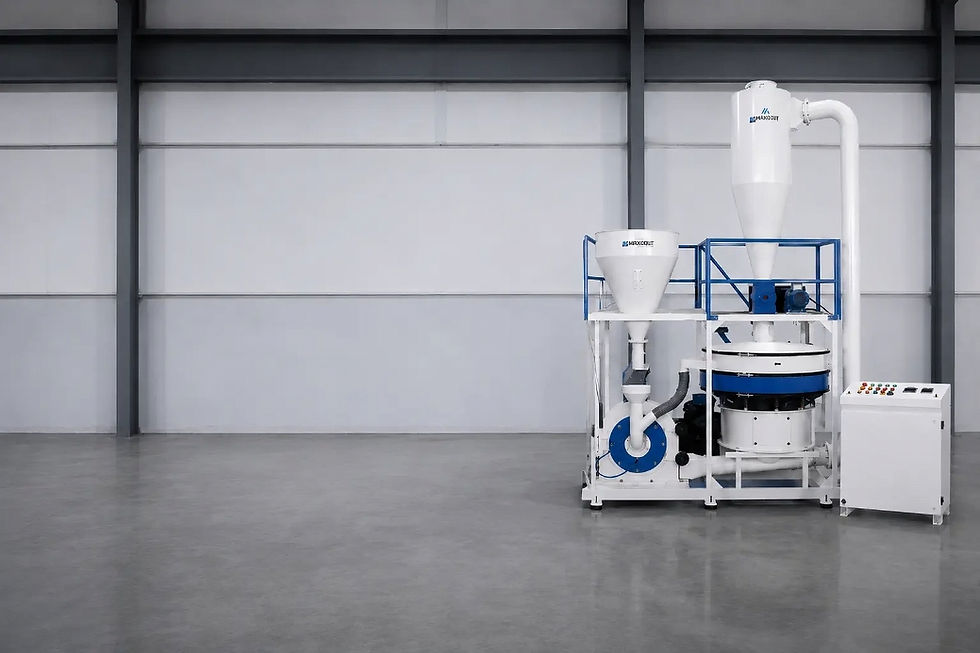
LLDPE (Linear Low-Density Polyethylene) is widely used for film, pipe, rotomoulding powder, and cable compound applications across India. Before LLDPE reaches these processes in usable form, it often needs to pass through one essential machine: the LLDPE pulverizer machine. This complete guide covers what it is, how it works, the types available, capacity selection, and how to choose the right manufacturer.
What Is an LLDPE Pulverizer Machine?
An LLDPE pulverizer machine grinds LLDPE granules or regrind into fine, uniform powder used in rotomoulding, cable compounding, masterbatch production, and certain film and pipe applications. Unlike PVC-based materials, LLDPE is a polyolefin with different melting and grinding characteristics, which is why pulverizer configuration (disc or rotor) is chosen based on the specific end application.
Maxoout Industries, based in Ahmedabad, Gujarat, has manufactured LLDPE pulverizer machines for over 12 years, with 1,200+ installations running across India and abroad, serving rotomoulding, compounding, and masterbatch industries.
Why LLDPE Is Pulverized
LLDPE is converted into fine powder for several important reasons:
Rotomoulding requirements — rotational moulding requires very fine, uniform LLDPE powder to coat mould surfaces evenly and produce defect-free tanks, containers, and playground equipment
Better additive dispersion — pigments, UV stabilizers, and fillers blend more evenly into fine LLDPE powder than into coarse granules
Masterbatch and compounding uniformity — fine powder ensures more consistent mixing when producing colour or additive masterbatches
Faster, more even melting — increased surface area speeds up melting in downstream processes, improving throughput
How an LLDPE Pulverizer Machine Works
Inside an LLDPE pulverizer machine, material is fed between grinding surfaces where mechanical shearing or impact breaks it down into fine particles. The process occurs in five stages:
Feeding — LLDPE granules or regrind are fed into the grinding chamber through a controlled inlet.
Grinding — material is processed via disc shearing (fine, rotomoulding-grade powder) or rotor hammer impact (faster throughput for less fineness-critical applications).
Cooling — dual air and water cooling manages heat build-up during grinding, particularly important given LLDPE's lower softening point compared to some engineering plastics.
Classification — a vibro screen separates powder that has reached the target fineness (often very fine mesh for rotomoulding) from material needing further grinding.
Discharge — a blower conveys the finished powder to storage silos or directly into the next process stage.
Because rotomoulding-grade LLDPE powder typically requires a very fine, consistent mesh, screen size selection and classification efficiency are especially important specifications for this application.
Types of LLDPE Pulverizer Machines (Disc / Rotor Type)
Maxoout manufactures LLDPE pulverizers in both configurations, selected based on application:
Disc Pulverizer Machine — Two hardened, German alloy steel grinding discs shear LLDPE granules into fine powder. This is the preferred configuration for rotomoulding-grade powder, where tight, consistent particle size is critical for even mould coating.
Rotor Hammer Type Pulverizer — Uses impact grinding via rotating hammer blades, delivering higher throughput for applications like general compounding or masterbatch production where extreme fineness is less critical than output volume.
Product Specification
MP 300 — Motor 15 kW — Output 120–200 kg/hr | MP 400 — Motor 30 kW — Output 200–300 kg/hr | MP 600 — Motor 55 kW — Output 400–600 kg/hr
Key Benefits of Using an LLDPE Pulverizer Machine
Fine, Rotomoulding-Grade Powder Output — tight particle size distribution suited to demanding rotomoulding specifications
Dual Air & Water Cooling — manages heat build-up during continuous grinding
Microprocessor-Based Control Panel — digital monitoring of grinding parameters and output speed
Low Power Consumption — energy-efficient motors reduce long-term running costs
Heavy-Duty Body Structure — built for continuous 24/7 industrial operation
Flexible Configuration — disc or rotor type selected to match your specific application
How to Choose the Right Capacity
Sizing an LLDPE pulverizer machine depends heavily on your end application:
Application type — rotomoulding typically requires finer mesh (lower effective throughput) compared to general compounding or masterbatch grinding
Daily production target — calculate your process's hourly LLDPE powder consumption and size the pulverizer accordingly
Required powder mesh size — rotomoulding-grade powder often needs 35-mesh or finer; coarser applications can run at higher throughput
Future expansion plans — if you plan to add rotomoulding or compounding capacity, consider sizing for future growth now
Common Mistakes to Avoid
Choosing rotor type for rotomoulding-grade powder — impact grinding typically cannot achieve the fine, consistent particle size rotomoulding requires; disc type is usually the correct choice
Ignoring cooling requirements — inadequate cooling can affect powder flow characteristics and consistency
Choosing on price alone — cheaper machines with soft discs wear faster and produce less consistent powder over time
Overlooking after-sales support — spare parts availability matters once your production line depends on daily uptime
Not clarifying your mesh requirement upfront — different applications need very different fineness; specify this clearly when ordering
Why Choose Maxoout for Your LLDPE Pulverizer Machine
Maxoout Industries is a leading LLDPE pulverizer machine manufacturer in Ahmedabad, trusted by rotomoulding processors, cable compounders, and masterbatch producers across Gujarat, Maharashtra, Rajasthan, Tamil Nadu, Uttar Pradesh, and internationally across Africa, the Middle East, and Southeast Asia.
12+ years of manufacturing experience, with every machine built in-house across 3 manufacturing units
1,200+ successful installations across India, including many rotomoulding and compounding applications
Customized machine solutions matched to your capacity, mesh size, and application requirements
Pan-India supply and international export, with full documentation and logistics support
After-sales service and support, including installation assistance, operator training, and spare parts supply
Frequently Asked Questions
Q: What is an LLDPE Pulverizer Machine used for?
An LLDPE Pulverizer Machine grinds LLDPE granules or regrind into fine powder used mainly in rotomoulding, cable compounding, and masterbatch production.
Q: Should I choose a disc or rotor type LLDPE pulverizer?
Disc type is generally preferred for rotomoulding-grade powder requiring fine, consistent particle size. Rotor hammer type suits applications where higher throughput matters more than extreme fineness, such as general compounding.
Q: What capacity LLDPE Pulverizer Machine do I need?
Maxoout machines range from 120 kg/hr (MP 300) up to 600 kg/hr (MP 600). The right model depends on your application, required mesh size, and production targets — contact our engineering team for a recommendation.
Q: How fine can an LLDPE Pulverizer Machine grind material?
Fineness depends on screen/mesh size and grinding configuration. Maxoout's disc-type machines can achieve the fine, rotomoulding-grade powder required by demanding applications.
Q: Does Maxoout export LLDPE Pulverizer Machines outside India?
Yes. Maxoout exports pulverizer machines to countries across Africa, the Middle East, and Southeast Asia, with full documentation and logistics coordination for international buyers.
Looking for an LLDPE Pulverizer Machine for your plant? Contact Maxoout Industries at +91 96015 11170 or get in touch here for a customized quote.


Comments